
Discover how APIs power AI applications, AI agents,...
The way software is built is changing.
Modern applications connect cloud platforms, databases, payment systems, mobile apps, third-party services, analytics platforms, AI models, and increasingly, AI agents.
Behind many of these connections is a technology that has existed for decades but is becoming even more important in the AI era: the API.
APIs are no longer simply mechanisms for requesting data. They are becoming a foundation for AI-powered applications, agentic workflows, real-time systems, enterprise integration, and connected digital platforms.
This article explores how APIs work today, how AI is changing their role, and where API-driven software is heading.
What Is an API?
An API (Application Programming Interface) is a defined interface that allows software systems to communicate with each other.
An API provides a structured way for one system to request information or functionality from another without needing to understand its internal implementation.
For example, an e-commerce application may communicate with:
- Product and inventory systems
- Payment providers
- Shipping platforms
- Authentication services
- CRM systems
- Notification services
- Analytics platforms
- AI services
Instead of building every capability internally, applications can communicate with specialized systems through APIs.
A simplified architecture looks like:
User → Application → API → Business Service → Database → API → Application
The user may never see the API, but it can power much of the communication behind the application.
How APIs Work
Most web APIs follow a request-and-response model.
- The client sends a request containing information such as the HTTP method, endpoint, authentication, parameters, and request data.
- The API validates the request and determines what operation is being requested.
- Business logic is executed, potentially involving databases, internal services, or external APIs.
- A result is generated or an appropriate error is returned.
- The API sends a response, commonly containing data, status information, or error details.
Many modern web APIs use JSON because it is lightweight and widely supported.
Client → API → Services → Data → API → Client
APIs Are More Than Data Endpoints
Traditional APIs often focus on retrieving or modifying data:
GET /products
POST /orders
PATCH /customers/123
DELETE /users/456
These patterns remain important.
However, modern applications increasingly use APIs to expose capabilities, not just data.
An API may allow an application to:
- Create an appointment
- Process a payment
- Generate a document
- Analyze an image
- Send a notification
- Search business data
- Generate an AI response
- Trigger a workflow
- Execute a business operation
This becomes particularly important when APIs are used by AI systems and autonomous agents.
APIs and Artificial Intelligence
AI is changing how applications use APIs.
A traditional application might use an API to retrieve customer information.
An AI-powered application may use APIs to retrieve customer information, search internal documents, call external services, execute business operations, and provide the resulting information to an AI model.
For example:
Customer Question → Application → API → Business Data → AI Model → API → Application → Customer
This allows organizations to introduce AI capabilities into existing software without rebuilding their entire technology stack.
APIs and AI Agents
AI agents take this further.
An AI model can generate content, reason over information, or analyze data. But an AI agent needs access to tools and systems when it is expected to perform real-world tasks.
For example, an AI assistant might:
- Search customer records
- Check product availability
- Retrieve an order
- Create a support ticket
- Schedule an appointment
- Send a notification
These capabilities can be exposed through APIs or other structured tool interfaces.
A simplified architecture is:
                         ┌── Customer API
                         │
AI Agent ── Tools ───────┼── Order API
                         │
                         ├── Payment API
                         │
                         ├── Search API
                         │
                         └── Notification API
The AI model provides reasoning and decision-making capabilities, while APIs provide controlled access to the systems that perform actual operations.
AI provides intelligence. APIs provide access to capabilities and systems.
APIs and Enterprise Architecture
Modern organizations rarely operate with a single application.
A typical technology environment may include:
- Websites
- Mobile applications
- CRM systems
- ERP platforms
- Payment systems
- Customer databases
- Communication platforms
- Data warehouses
- Cloud services
- AI systems
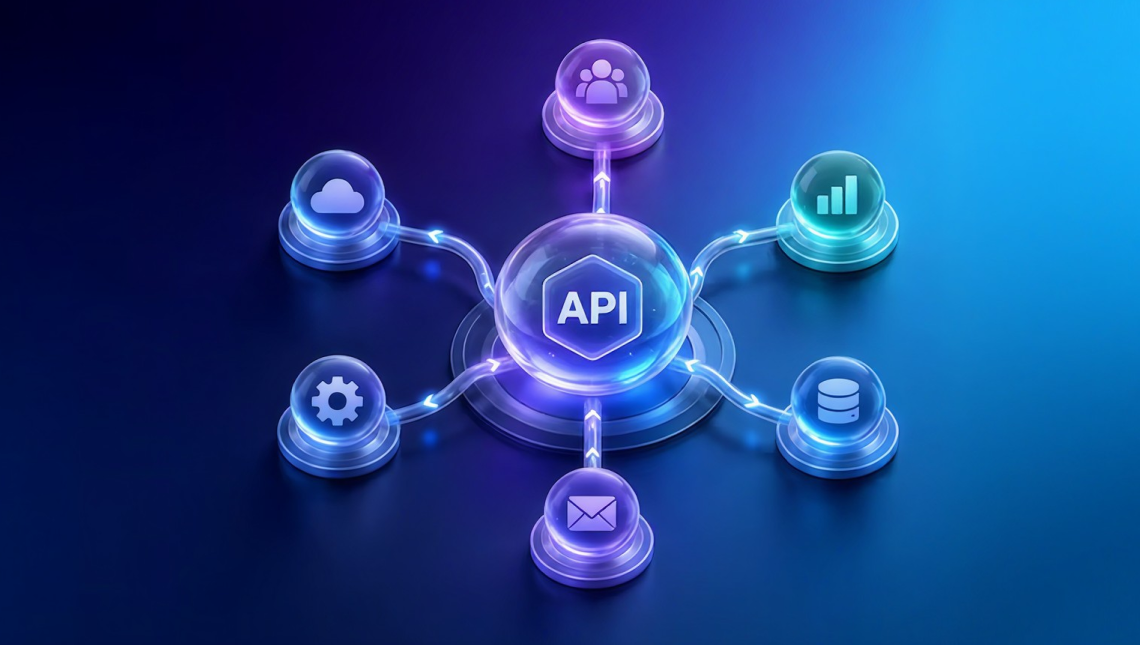
APIs provide a structured way to connect these systems.
                         ┌── Web Application
                         │
                         ├── Mobile Application
Users ── Platform ───────┼── CRM
                         │
                         ├── ERP
                         │
                         ├── Payment Services
                         │
                         └── AI Services
This connected architecture allows organizations to introduce new applications and capabilities without necessarily rebuilding every existing system.
APIs, Microservices, and Modular Systems
APIs are commonly used in modular architectures and microservices.
A system may contain separate services for:
- Authentication
- Customers
- Orders
- Payments
- Notifications
- Search
- Reporting
- AI processing
These services can communicate through well-defined interfaces.
However, microservices are not automatically better simply because they use APIs. They introduce additional complexity around:
- Network communication
- Distributed tracing
- Failure handling
- Security
- Monitoring
- Data consistency
- Deployment
The goal should be appropriate separation, rather than creating services simply for the sake of creating services.
API Security
As APIs connect applications, businesses, and AI systems, security becomes increasingly important.
API security can involve:
- Authentication
- Authorization
- OAuth
- API keys
- Access tokens
- Role-based access control
- Rate limiting
- Input validation
- Encryption
- Audit logging
- Monitoring
- Threat detection
AI-powered applications introduce another important consideration.
For example, an AI agent may be allowed to read customer information but not delete a customer account.
Therefore, APIs should enforce precise permissions rather than relying on the AI system to behave correctly.
Never assume that an AI model is a security boundary.
The underlying API and business systems should enforce authorization independently.
API Design Matters
As organizations expose more capabilities through APIs, API design becomes an architectural concern.
A well-designed API should consider:
Consistency
Endpoints, naming conventions, request structures, and responses should follow predictable patterns.
Versioning
Changes should avoid unnecessarily breaking existing consumers.
Validation
Incoming requests should be validated before business operations are performed.
Idempotency
Operations such as payments and order creation may require protection against accidental duplicate execution.
Error Handling
Errors should provide structured information that applications can handle appropriately.
Observability
Organizations need visibility into API performance, failures, latency, and usage.
Documentation
Clear API documentation helps developers and increasingly AI systems understand available capabilities.
APIs and Real-Time Applications
Not every application works well with traditional request-and-response communication.
Modern products may require real-time communication for:
- Chat applications
- Notifications
- Financial dashboards
- Monitoring systems
- Collaboration tools
- Delivery tracking
Technologies such as WebSockets can maintain persistent, two-way communication between clients and servers.
Client ↔ Real-Time Service ↔ Business Systems
This allows applications to receive updates without repeatedly requesting them.
REST, GraphQL, WebSockets, and Event-Driven APIs
Different requirements call for different communication patterns.
REST
REST remains widely used for web APIs and resource-oriented services.
Common HTTP methods include:
- GET
- POST
- PUT
- PATCH
- DELETE
GraphQL
GraphQL allows clients to request specific fields and relationships from a defined API schema.
WebSockets
WebSockets provide persistent, two-way communication for real-time applications.
Event-Driven Architecture
Modern systems can also use asynchronous events.
For example:
Order Created → Event → Inventory Service → Notification Service → Analytics
The appropriate approach depends on requirements such as latency, consistency, scalability, and operational complexity.
APIs and RAG-Based AI Systems
Modern AI applications often need information beyond the model's original training data.
A retrieval-augmented generation (RAG) system may retrieve information from:
- Internal documents
- Product catalogs
- Knowledge bases
- Databases
- Search systems
- Business applications
APIs can connect these sources to an AI application.
User → AI Application → Search API → Relevant Data → AI Model → Response
For enterprise AI, this connection between AI models and authoritative business data is particularly important.
The AI model generates the response, while APIs and underlying systems control what information the application can access.
The API Gateway as a Control Layer
As applications communicate with many services, organizations may introduce an API gateway.
A gateway can provide:
- Request routing
- Authentication
- Rate limiting
- Logging
- Monitoring
- Request transformation
- Policy enforcement
A simplified architecture is:
Client Applications
        ↓
   API Gateway
        ↓
   ┌─────┼────────┐
   ↓     ↓        ↓
  CRM   Orders   AI Services
   ↓     ↓        ↓
 Data   Data    Models
For larger systems, additional layers may be introduced based on security, networking, scalability, and operational requirements.
The Future of APIs
The future of APIs is not simply about creating more endpoints.
It is about creating reliable, discoverable, secure, machine-readable capabilities that can be used by applications, developers, automation systems, and AI agents.
Several trends are likely to shape API architecture:
APIs Designed for AI Consumption
API schemas and documentation may increasingly need to be understandable to AI systems. Clear descriptions of operations, parameters, permissions, outputs, and failure conditions can help AI systems use APIs more safely.
More Machine-to-Machine Interaction
Software systems will increasingly communicate with other software systems without direct human involvement.
Stronger Authorization
As applications and AI agents gain the ability to perform actions, precise permission boundaries become increasingly important.
Event-Driven Architectures
Organizations will increasingly combine synchronous APIs with asynchronous events for scalable workflows.
API Observability
Understanding which applications, users, agents, and services are calling an API will become increasingly important for reliability and security.
API Governance
Larger organizations will need consistent policies around API design, security, versioning, ownership, documentation, and lifecycle management.
APIs Will Remain Important as AI Advances
AI is changing software development, but it does not remove the need for system architecture.
An AI model can generate code.
An AI agent can reason about a task.
An AI assistant can interact with tools.
But organizations still need reliable systems that:
- Store data
- Enforce permissions
- Process transactions
- Manage users
- Execute business rules
- Communicate with external services
- Maintain audit trails
- Protect sensitive information
APIs provide one of the interfaces through which these capabilities can be exposed and consumed.
The growth of AI may therefore increase the importance of well-designed APIs rather than eliminate them.
From APIs to Intelligent Digital Platforms
The evolution can be viewed as:
Traditional Applications
        ↓
Connected Applications
        ↓
API-Driven Platforms
        ↓
Cloud & Modular Systems
        ↓
AI-Powered Applications
        ↓
AI Agents + APIs + Business Systems
        ↓
Intelligent Digital Platforms
Software is becoming increasingly interconnected.
Applications can retrieve information, interact with external services, invoke business capabilities, and use AI to determine which operations may be appropriate within defined boundaries.
APIs remain a critical part of this connected architecture.
Conclusion
APIs have evolved from simple application interfaces into a foundation for modern digital systems.
APIs connect applications, cloud services, enterprise platforms, data systems, AI models, automation workflows, and increasingly AI agents.
As software becomes more intelligent and interconnected, API architecture becomes increasingly important.
Organizations that build APIs with security, reliability, scalability, observability, clear contracts, and AI-ready interfaces can create technology platforms that are easier to integrate and evolve.
The API may remain invisible to the end user, but behind the modern digital experience, it can be the layer connecting applications, data, services, automation, and intelligence.